Types of Foundation Cracks: An Observation Guide for Cobb County Homeowners
Need help with your own home?
Tell us your concern. We'll check local contractor availability.
No referral fee · No obligation to hire
What are the main types of foundation cracks and how serious is each one?
Vertical, diagonal, stair-step, horizontal and slab cracks describe appearance, not a reliable ranking of seriousness. Width, displacement, changes, water entry, construction and other evidence matter. Seek appropriate professional advice for concerns and keep clear of immediate hazards.
Crack direction and appearance can organize questions, but no ranking diagnoses a property. Width, displacement, change over time, moisture, drainage, foundation type, and site evidence determine urgency; ask a qualified professional to assess concerning changes.
Do not infer a cause or repair from a pattern alone. The assessment guide helps you ask about investigation, credentials, fees, limitations and written findings.
The sections below explain observations and questions. Neither this guide nor a general visit guarantees a severity determination or repair scope.
What do hairline and vertical cracks in a concrete foundation mean?
A narrow vertical crack may relate to shrinkage or another condition, but width and orientation alone do not establish its cause or safety. Document water entry, displacement and changes and seek appropriate advice where needed.
Concrete can crack as it shrinks, but a coin or visual width test does not diagnose the cause. Avoid assuming that a narrow crack is harmless or that a wider one needs a particular material.
Water entry may require separate investigation. Ask what observations support any proposed injection, drainage or structural work, and confirm assessment fees and scope directly.
The assessment guide helps prepare questions. Seek prompt advice for significant change or safety concerns rather than relying on a universal waiting period.
- Record location, width, offset and dates without entering an unsafe area.
- Note water entry and whether it changes with weather.
- Ask what investigation supports any proposed explanation.
- Do not conceal a crack or choose a treatment solely from its width.
- Keep clear of immediate hazards and seek appropriate emergency help.
What causes diagonal cracks radiating from window and door corners?
Cracks around openings can relate to several types of movement or material behavior. Their angle does not, by itself, prove settlement. Document width, offset and changes and ask what property-specific investigation is appropriate.
Openings can influence crack patterns, but matching interior and exterior cracks do not establish the cause beneath a footing. Site observations and measurements need to be interpreted together.
A widening crack or accompanying floor change warrants appropriate attention, not automatic pier selection. See the symptom guide for observations to record.
Separating or displaced masonry may present a safety concern regardless of neighborhood or house age. Keep clear of immediate hazards and seek appropriate professional help; the assessment guide is not emergency dispatch.
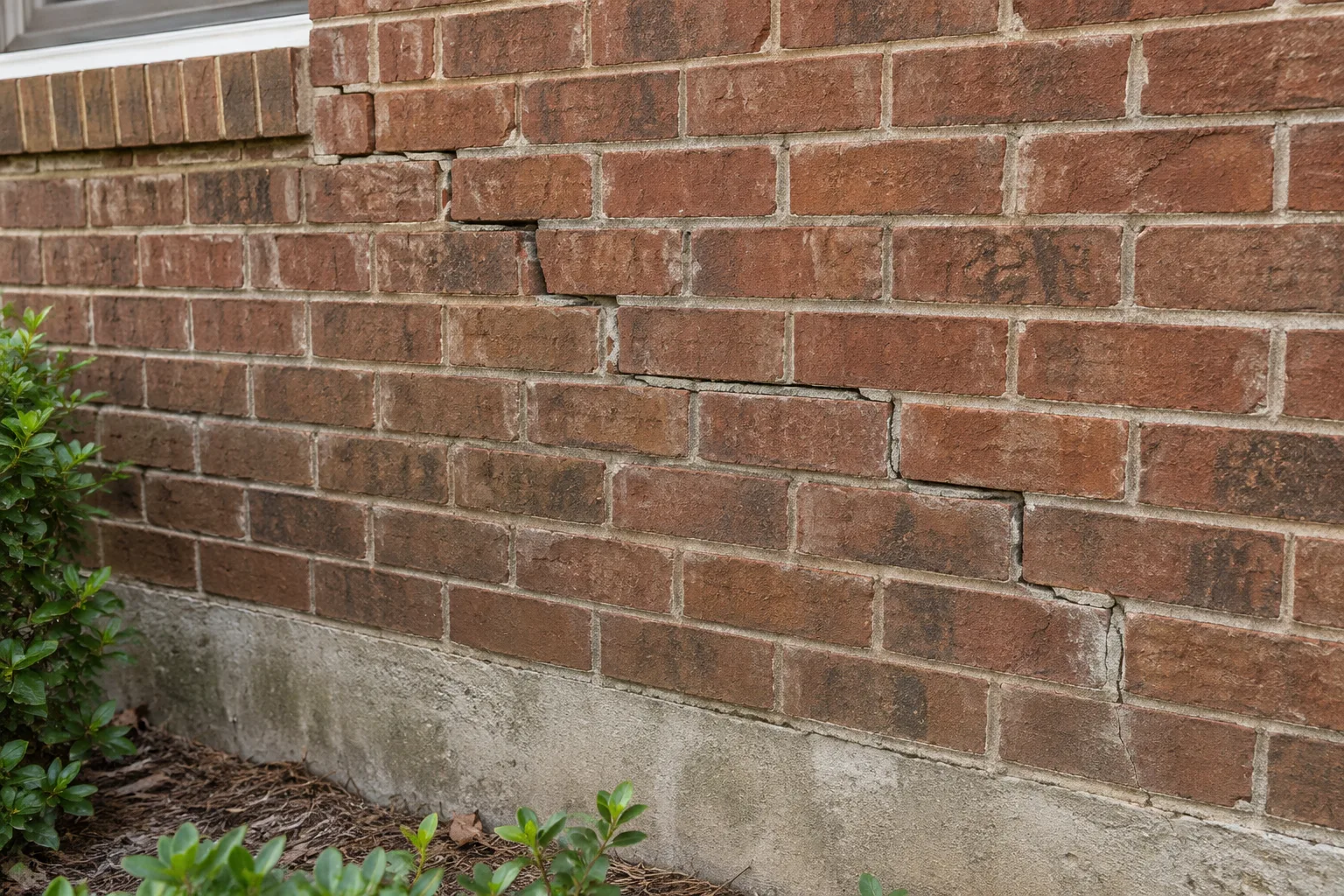
What are stair-step cracks in brick or block, and are they serious?
Stair-step cracks follow mortar joints and can reflect differential movement, but they do not establish a cause or repair. A contractor should review width, displacement, change over time, foundation type, drainage, fill, and other evidence before discussing piers, injection, monitoring, or another method.
Mortar joints can influence the path of a masonry crack, but a stair-step pattern may reflect differential movement, mortar behavior, construction details or another condition. It may be cosmetic, injectable or structural depending on width, displacement, change, substrate, moisture and site evidence; the pattern alone cannot choose a category.
West Cobb soil and rock mapping is regional context, not a property diagnosis. Ask about foundation type, drainage, fill and movement history.
For stair-step cracking, a contractor may discuss masonry repair, injection, monitoring, drainage, structural support or another method. Ask for measured movement, proposed bearing conditions, alternatives and written limitations before authorizing work.
- Crack follows mortar joints: document pattern and possible masonry causes without assigning a diagnosis
- Displacement or lipping: record offset and seek qualified review
- Crack wraps an exterior corner: document both wall faces
- Stair-step pattern with interior changes: provide the combined observations for assessment
- Stable narrow crack: ask whether cosmetic repair, monitoring or another scope fits the evidence
Why should horizontal cracks receive prompt attention?
Horizontal cracks may be associated with wall loading or movement, but orientation alone does not establish the cause, urgency or repair. Seek prompt professional assessment. If there is sudden movement, collapse risk or another immediate hazard, keep clear and contact appropriate emergency services rather than relying on a referral form.
Lateral loading, construction details and other conditions may be relevant. A regional clay label cannot establish saturation depth, pressure or structural capacity at your property. Ask what observations and measurements support the assessment.
Carbon-fiber straps or wall anchors may be discussed for measured wall movement. Published ranges are rough budgeting context only, not verified Cobb County price data or a quote. Ask who is designing the scope, what is measured, and which alternatives were considered. See horizontal foundation cracks.
Document a crack's location, width, offset and change without entering an unsafe area. There is no universal one-inch or three-inch rule that selects a repair. The assessment guide helps prepare questions; a referral request does not provide emergency response.
What do cracks in a concrete slab floor mean?
Slab cracks may relate to material behavior, construction, support conditions or other causes. Changes and displacement deserve attention, but their appearance does not establish soil washout or select a repair.
Neither a narrow flat crack nor an offset one establishes a subsurface diagnosis by itself. Record the condition and ask what measurements and investigation are appropriate; a nearby creek does not prove washout.
For a wall with lateral movement, a contractor may discuss carbon-fiber straps, steel braces, anchors, drainage, or another method. Published ranges are rough budgeting context only. Ask for measured deflection, spacing or locations, design basis, alternatives, and written limitations before authorizing work. Learn more on our horizontal foundation cracks page.
Post-tensioned slabs contain stressed tendons that can be dangerous to cut or drill. Confirm the slab system and utility locations with appropriate professionals before intrusive work. Do not assume that a general visit includes this investigation.
How do I tell a cosmetic crack from a structural one?
Width, growth, displacement, water entry and companion signs can help organize follow-up, but no universal threshold classifies a crack as cosmetic or structural. Ask a qualified professional to interpret measurements and site evidence.
Width alone is not enough. Record location, width, offset and dates when safe, and ask what monitoring interval is appropriate; do not treat a visual comparison or a fixed interval as a remote safety verdict.
Doors or windows that stick, sloping floors, trim gaps, seepage or a tilting chimney can have multiple causes. Report companion observations without assuming they prove ongoing movement.
An assessment may include crack mapping, width measurement, floor readings and review of accessible conditions. This service does not diagnose the property; confirm assessment fee and terms directly.
- Record width, offset and dates without entering an unsafe area
- Document growth or changing water entry and seek qualified review
- Displacement or wall bowing warrants prompt professional assessment
- Horizontal cracking or other immediate hazards: keep clear and seek appropriate help
- Stable appearance alone does not establish cause, safety or treatment
How does Marietta Foundation Repair work and who actually does the repair?
Marietta Foundation Repair is not a contractor. We are a disclosed referral service operated by Stratum Relay LLC. If a suitable contractor is available, we may introduce you; availability and credentials are not guaranteed. Verify identity, license, insurance, assessment fee, scope, schedule, and warranty directly. The referral request has no fee from this service; if an introduction is arranged under a referral agreement, the contractor may compensate us.
If you call (678) 329-9460 or submit the contact form, we may check whether a suitable contractor is available across the stated service area. An introduction is not guaranteed. If available, the contractor contacts you directly, and you verify identity, license, insurance, fee, scope, and schedule.
The referral request has no fee from this service. Any contractor assessment, engineering, repair, or warranty fee is confirmed directly. We do not perform or supervise the work. A referral agreement, if arranged, may compensate this service, but the contractor sets the assessment and repair terms.
This service does not vet contractors. Use how to vet a foundation contractor in Cobb County for questions to ask, then verify credentials, references, fee, scope, schedule, and warranty directly.
Frequently asked questions
Can I fill a foundation crack myself with hydraulic cement or caulk?
Surface patching may address limited water entry but does not automatically address movement. If a crack changes, ask what evidence supports injection, monitoring, drainage, or structural work. Published injection ranges are rough budgeting context, not verified Cobb County price data or a contractor quote.
How fast do foundation cracks typically grow in Cobb County?
Growth rate depends on the cause and site conditions. Document width, displacement, moisture, and dates; monitor only when a qualified professional says that is appropriate. A regional Cecil soil label cannot predict how a particular crack will change.
Does homeowner's insurance in Georgia cover foundation crack repairs?
Coverage depends on the policy, covered event, exclusions and documented cause. Do not infer coverage from a regional soil explanation; ask the insurer or claims professional about the observed loss and applicable product terms.
What is the difference between epoxy and polyurethane crack injection?
Epoxy and polyurethane have different properties and may fit different crack conditions. Ask the contractor to explain moisture, movement, wall type, intended function, alternatives, limitations, and written price terms. Published ranges are rough budgeting context, not verified Cobb County price data or a contractor quote.
Are stair-step cracks in the brick exterior always a foundation problem?
Not always. Brick veneer may crack from masonry behavior, construction or movement, and the pattern alone does not establish footing movement. Document width, displacement and companion observations and obtain qualified review before choosing tuckpointing or structural work.
How many piers does a typical settling home in Marietta need?
Published ranges of $1,400–$3,500 per pier and $3,500–$25,000 overall are rough budgeting context only. Pier count and method depend on measured load path, foundation type, access, bearing conditions, and the written scope; ask for alternatives and installation records.