Foundation Repair FAQ — Cobb County Homeowners' Questions Answered
Need help with your own home?
Tell us your concern. We'll check local contractor availability.
No referral fee · No obligation to hire
Are you a foundation repair contractor, or how does this referral service work?
We are not a contractor. Marietta Foundation Repair is a disclosed lead-referral service operated by Stratum Relay LLC. If a suitable contractor is available, we may introduce you; availability and credentials are not guaranteed. Verify identity, license, insurance, assessment fee, scope, schedule, and warranty directly. The referral request has no fee from this service; if an introduction is arranged under a referral agreement, the contractor may compensate us.
Call (678) 329-9460 or submit a request to ask about contractor availability. No response, introduction or visit is guaranteed. Confirm any contractor's credentials, fees, scope and schedule directly.
The referral request has no fee from this service. Any contractor assessment, engineering, repair, financing, or warranty fee is confirmed directly. If an introduction is arranged under a referral agreement, the contractor may compensate us; we do not set the contractor’s prices.
If you want to evaluate any contractor, see our guide to how to vet a foundation contractor in Cobb County before committing to work.
How much does foundation repair cost in Cobb County?
Costs depend on the supported method, quantities, access and terms. Published dollar figures are illustrative planning ranges, not verified Cobb County prices or a minimum charge. Confirm assessment fees and any proposal directly.
Costs vary widely because foundation problems are not one-size-fits-all. Published ranges are rough budgeting context only. Use the cost estimator for planning, and ask a contractor for a written scope. The USDA Official Series Description for Cecil classifies mapped Cecil soils as low shrink-swell; that regional map is not a diagnosis.
Different methods address different conditions and have different quantities and exclusions. Use the figures below only as rough planning examples; a ZIP code or symptom does not establish the price.
For a full cost breakdown by repair type, see our foundation repair cost guide for Marietta. Confirm assessment fees and contractor terms directly.
- Crack injection: $300 – $3,000 These figures are rough budgeting context, not verified Cobb County price data or a contractor quote.
- Helical or push piers: $1,400 – $3,500 per pier These figures are rough budgeting context, not verified Cobb County price data or a contractor quote.
- Slab leveling / mudjacking: $600 – $2,500 These figures are rough budgeting context, not verified Cobb County price data or a contractor quote.
- Crawl space encapsulation: $5,000 – $12,000 These figures are rough budgeting context, not verified Cobb County price data or a contractor quote.
- Bowing wall (carbon fiber or anchors): $1,750 – $6,000 These figures are rough budgeting context, not verified Cobb County price data or a contractor quote.
- Basement waterproofing: $2,000 – $10,000 These figures are rough budgeting context, not verified Cobb County price data or a contractor quote.
- Inspection: contractor-confirmed terms
What are the warning signs that I need foundation repair?
Cracks, sticking openings, floor changes, trim gaps, water entry and chimney changes can help describe a concern. None alone diagnoses a cause or selects repair. Document changes safely and seek appropriate professional advice.
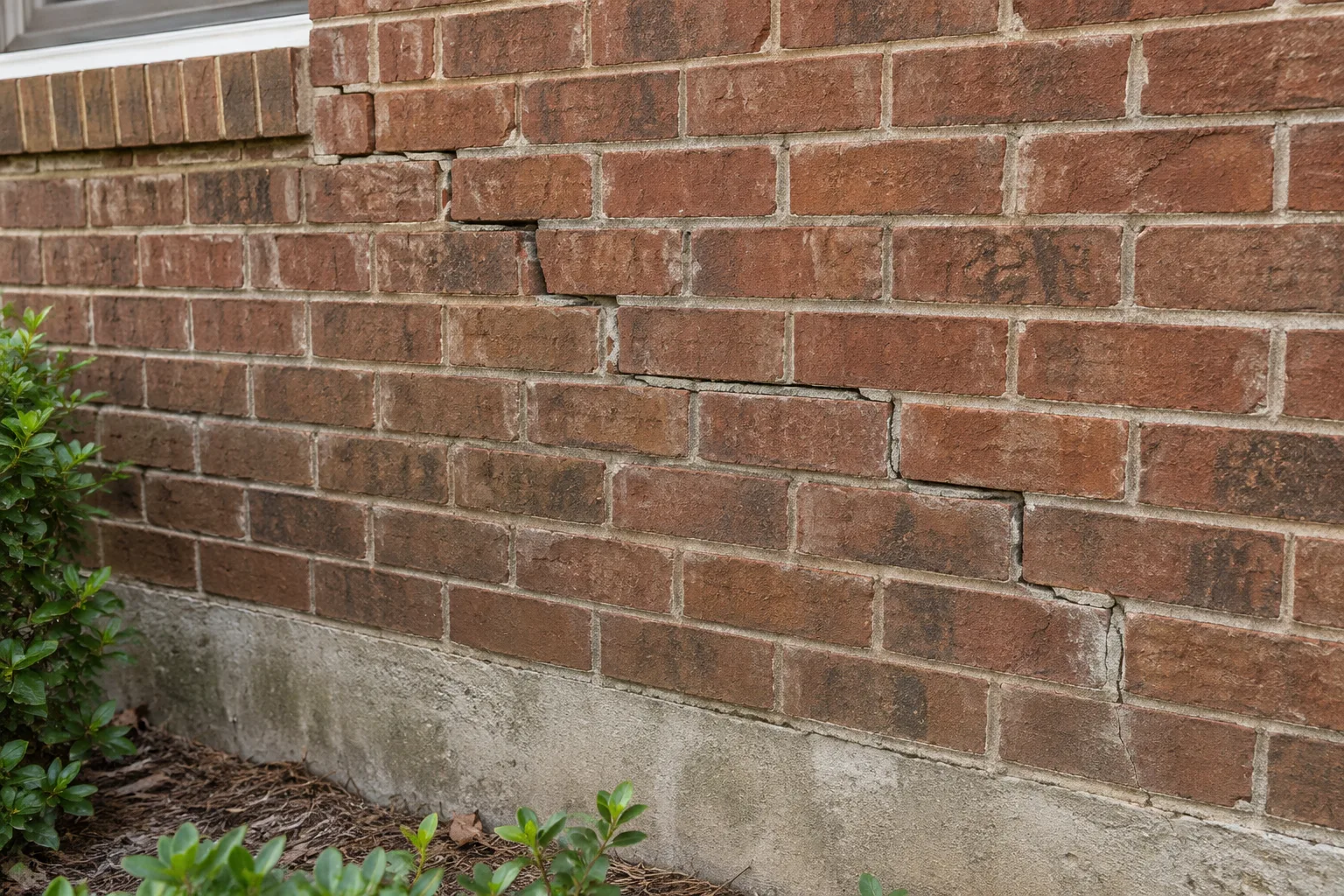
Stair-step cracking, diagonal drywall cracks, sticking doors, sloping floors, trim gaps, and water entry are observations that may warrant review. None diagnoses a cause alone. See the full list on our warning signs page.
Sloping or bouncy floors can have several explanations, including framing and support conditions. A simple level reading does not distinguish settlement, heave or construction variation. Ask what measurements and investigation support any diagnosis.
Horizontal cracks in a block or poured-concrete basement wall can raise a lateral-pressure concern. If you see one, document its location, width, displacement, water entry, and change over time. Request an assessment through the foundation inspection guide if appropriate.
- Stair-step cracks in brick mortar joints
- Diagonal drywall cracks at door and window corners
- Doors or windows sticking or no longer latching
- Sloping, bouncy, or sagging floors
- Gaps appearing at trim, baseboards, or crown molding
- Water seeping into basement or crawl space after rain
- Tilting chimney or exterior steps pulling away from the house
What site conditions can matter for a Cobb County foundation?
Drainage, fill, soil, foundation details and construction history can matter, but this guide does not establish a higher failure rate for Cobb County or diagnose your property.
Mapped soil information can provide regional context, but conditions vary by lot. Drainage, fill, roots, foundation type, grading, and construction history also matter. Ask for field evidence before accepting a soil-based explanation.
Weathered materials and soil layers can vary over short distances. A location near a mountain or lake does not establish bearing conditions or prove that a footing crosses different materials. Site investigation, where warranted, is more useful than a regional assumption.
A home's age does not establish its footing depth, code compliance or cause of distress. Review available plans, prior work and observations with an appropriate professional. We do not claim a verified breakdown of local foundation failures or customer calls by house age.
What repair methods are used and how do I know which one my home needs?
Methods can include deep support, crack treatment, slab work, framing repair, wall reinforcement or drainage measures, but each has different purposes and limits. Ask what investigation and design support the proposal. Neither the symptom list nor an assessment visit guarantees a particular diagnosis or repair.
A contractor may discuss helical piers, push piers, crack injection, drainage, or another method after reviewing measurements and conditions. See helical piers for method questions; the choice is not automatic.
Crack repair depends on moisture, movement, wall type, and cause. See the epoxy-versus-polyurethane comparison. Any recommendation should identify evidence, alternatives, limitations, and price terms directly.
Crawlspace, basement, drainage, and framing scopes vary by property. An assessment if available may document accessible conditions and alternatives; see the on-site inspection guide.
What should I confirm before scheduling an inspection?
If an introduction is available, a contractor may assess the property and provide a written estimate. Confirm any assessment fee, scope, schedule, and availability directly; there is no obligation to hire, and the referral request has no fee from this service.
If a contractor offers an assessment, ask whether it covers exterior conditions, interior cracks or floor levels, accessible crawl-space or basement areas, moisture and written findings. The contractor determines methods, access requirements, deliverables and fees. A referral is not verification of credentials or a promise of an itemized estimate.
Confirm any schedule directly with the contractor. For sudden structural movement, an unstable wall, dangerous flooding or another immediate hazard, stay clear and contact emergency services, the utility or an appropriate available professional. This referral line does not dispatch emergency assistance.
After an assessment, you may decline to hire. Any contractor assessment fee, scope, and availability are confirmed directly. Compare measurements, alternatives, exclusions, and warranty terms before deciding. Related guide: learn more.
Frequently asked questions
What do stair-step cracks in my brick mean — are they serious?
A stair-step pattern follows masonry joints but does not, by itself, diagnose settlement or stability. Document its location, width, offset and changes. Significant change, displacement or other concerns warrant appropriate assessment; no single width proves that it is safe.
Are horizontal cracks in my basement wall an emergency?
Horizontal cracks can raise concern about wall loading or movement and warrant prompt professional assessment, but orientation or a single deflection measurement does not select the repair. Keep clear and contact appropriate emergency services if there is sudden movement or an immediate hazard. A referral request is not emergency dispatch.
What is the difference between helical piers and push piers, and which do I need?
Helical piers are rotated into the ground, while push piers are hydraulically advanced using structural reaction force. The choice depends on foundation type, load, access, measurements, and installation evidence; ask the contractor to explain it. Published per-pier ranges are rough budgeting context only.
Does homeowner's insurance cover foundation repair in Georgia?
Coverage depends on your policy, endorsements, exclusions and the facts of the loss. Soil movement or settling may be excluded, but this guide cannot determine coverage. Review the policy and ask your insurer; see the <a href="/foundation-repair-insurance-georgia">insurance guide</a> for preparation questions.
Is financing available for foundation repair?
Financing depends on the contractor or lender and is not offered by this referral service. If an introduction is available, ask about payment options, APR, fees, eligibility, and total repayment directly. Published repair ranges are rough budgeting context, not a financing offer.
What warranty does foundation repair come with?
Warranty scope, duration, exclusions, and transferability vary by contractor or manufacturer. Ask for written terms before signing. This referral service does not issue or guarantee a warranty; see <a href="/foundation-repair-warranty-explained">the warranty explainer</a>.
How long does foundation repair take to complete?
Duration depends on the agreed method, quantities, access, engineering or permitting requirements, weather and unforeseen conditions. Ask the contractor for a project-specific schedule, disruption and return-to-use restrictions. This referral service does not guarantee a start date or completion time.
Do you serve all of Cobb County, including Kennesaw, Acworth, and Powder Springs?
We may check whether a suitable contractor is available in the listed communities, but coverage and timing are not guaranteed. Confirm availability, identity, license, insurance, assessment fee, scope, and schedule directly.
What is crawl space encapsulation and do I need it?
Encapsulation describes a possible moisture-control scope that may include barriers, equipment or other measures. Need and design depend on the actual source and building. Confirm limitations, maintenance and any separate remediation or structural work; neither a symptom nor regional humidity selects the system.
Can a cracked foundation be a dealbreaker when selling a home in Marietta?
A repaired foundation may be easier to document for a future buyer, but buyer, lender, and warranty outcomes are not guaranteed. Ask for measurements, written scope, exclusions, and any warranty terms directly before relying on a repair record.
What is the difference between basement waterproofing and crawl space encapsulation?
The terms describe work in different building spaces and may involve different water paths, materials and equipment. Ask for the actual moisture source, proposed components, limitations, maintenance and separate structural or remediation scope. Neither label guarantees a particular system or result.
What happens if I ignore foundation cracks and do nothing?
A small repair may cost less than a larger structural scope, but no repair price or method is automatic. Ask for measurements, a written scope, alternatives, exclusions, and warranty terms. Published ranges on this site are rough budgeting context, not verified Cobb County price data or a quote.